


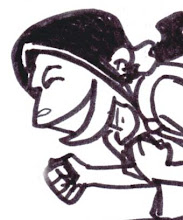
Gorillaz is a musical project created in 1998 by Damon Albarn of Britpop band Blur and British cartoonist Jamie Hewlett, co-creator of the comic book Tank Girl. In the mainstream and commercial outlets it is known as a "virtual band" because for their image and promotion, instead of displaying the musicians of the band, it has used a group of comic book characters. The "virtual band" is composed of four animated members: 2D (lead vocalist, keyboard), Murdoc Niccals (bass guitar), Noodle (guitar and occasional vocals) and Russel Hobbs (drums and percussion). The music is a collaboration between various musicians, Albarn being the only permanent musical contributor. Their style is a composition of multiple musical genres, with a large number of their influences including: dub, hip hop, alternative rock, electronic and pop music.
The band's 2001 debut album Gorillaz sold over seven million copies and earned them an entry in the Guinness Book of World Records as the Most Successful Virtual Band. It was nominated for the Mercury Prize 2001, but the nomination was later withdrawn at the band's request. Their second studio album, Demon Days, was released in 2005 and included the singles "Feel Good Inc.", "Dare", "Dirty Harry" and "Kids with Guns"/"El Mañana". Demon Days went five times platinum in the UK, double platinum in the United States and earned five Grammy Award nominations for 2006Best Pop Collaboration with Vocals category. Gorillaz have also released two B-sides compilations and a remix album. The combined sales of Gorillaz and Demon Days had, by 2010, exceeded 20 million albums. The band's third studio album, titled Plastic Beach, was released in 2010. On 26th May 2010, it was announced that the band would replace U2 as Glastonbury Festival hea dliners. and won one of them in the

Gorillaz is a character
The story of Gorillaz is a characteristally messy one. Saturday Boy Stu-Pot, a keyboard obsessive and nice kid dullard, is the star employee at Uncle Norm's Organ Emporium, on course to make regional manager. But then comes a Saturday to end all weeks (just like a Sunday, but with shopping).
Murdoc, with his nasty bad boy crew, ramraids the shop in a tatty Vauxhall Astra. His plan: to seize the synths and form a chart topping band with the booty. He drives... SMASH!... through the shop window and... SMASH!... into Stu-Pot's head, fracturing his eyeball. Result: 30,000 hours of community service for Murdoc, plus 10 hours every week of caring for the vegetabilised Stu-Pot.
Soon, Murdoc's rotten driving skills again force life to take a different turn. While attempting a 360 doughnut spin in Nottingham's Tesco carpark, he catapults Stu-Pot through the windscreen and into a kerb. Stu-Pot's other eye is fractured, his mind is revived and he stands a young, black eyed god, with hedgehog hair and a vacant stare. Not only that, but his synth playing takes a serious turn for the weird.
Perfect pop material. Stu-Pot is renamed 2D (because he's got two dents in his head). Now Murdoc needs a drummer.
Rewind a few years. In New York State, Russel, a middle-class kid, is forced out of his posh private school due to his being possessed by a demon. He lies in a coma for four years, until an elaborate exorcism sets him free. Russel joins Brooklyn High, where he falls in with a group of talented street musicians, rappers and DJs. Hip-Hop saves his soul. For a time. A random drive-by shooting kills all of his friends and as Russel, the lone survivor, lies in a state of shock, the spirits of his chums invade his body, turning Russel's eyes a spooky white and giving him amazing drumming, rapping and general hip-hop skills.
His parents move him to England, where they hope he'll have the chance of a quieter life. They hadn't reckoned on Murdoc, who tracks Russel down in a Soho Rap Record Store. Now, all the fledgling group need is a guitarist. They place an ad in the NME. The day the ad is published, a Fed-Ex'd freight container is delivered to their door. Out jumps a small Japanese person carrying a Les Paul. She jabbers at them incomprehensibly, before launching into a riff to end all riffs, rounding it off with a hi-karate jump. The boys are speechless. Noodle has one word for them. It is Noodle.
Gorillaz are born, and signed amidst the mayhem of their very first gig. Such is the way legends are created 


